



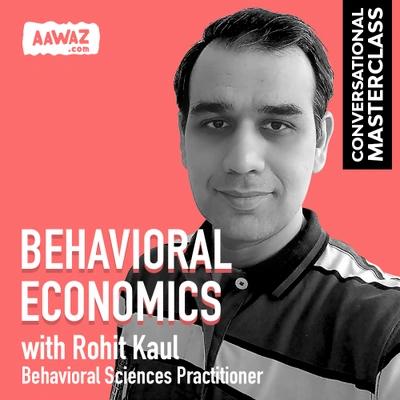
Behavioral Economics with Rohit Kaul
Duration
2hr 32m
Language
English
Released
Category
Masterclass


Favorite

Review

Play

Share
Read More


1 - Pilot
01 min 33 sec


8


Episode info


Share Episode


2 - Introduction to Behavioral Economics
30 min 04 sec
9
Episode info
Share Episode

3 - Key Actors and Key Concepts Part I
33 min 16 sec
4
Episode info
Share Episode

4 - Key Actors and Key Concepts Part II
35 min 13 sec
2
Episode info
Share Episode

5 - Heuristics and Biases Part I
27 min 30 sec
2
Episode info
Share Episode

6 - Heuristics and Biases Part II
24 min 59 sec
2
Episode info
Share Episode
Behavioral Economics with Rohit Kaul
About Show
| Episodes | Duration | |||
1 . PilotIntroduction to the Podcast More | 01 min 33 sec | |||
2 . Introduction to Behavioral EconomicsUnderstand the fundamentals of Behavioral Economics, get a brief historical view of Microeconomics, Classical and Neoclassical Economics. Delve into the importance of Behavioral Economics. More | 30 min 04 sec | |||
3 . Key Actors and Key Concepts Part Integral to understanding Behavioral Economics are the following key concepts: <b>Bounded Rationality (Herbert Simon) -</b> According to this view, our decisions are not always optimal. Primarily due to restrictions on how much information we can process, limited by either our knowledge or information. <b>Heuristics & Biases (Kahneman and Tversky) -</b> Daniel Kahneman and Amos Tversky’s ideas on ‘heuristics and biases’ entered the mainstream decades after they first proposed it. It is the understanding of economic decisions based on measuring actual choices made under different conditions. <b>Prospect Theory (Kahneman and Tversky) - </b>This shows our willingness to take risks is influenced by the way in which choices are framed, it is ‘context-dependent’. Kahneman was awarded the Nobel Memorial Prize in 2002 for his work on ‘Prospect Theory’. More | 33 min 16 sec | |||
4 . Key Actors and Key Concepts Part IIKey concepts discussed on this episode are: <b>System 1 and 2 (Kahneman and Tversky) -</b> The central thesis is a dichotomy between two modes of thought: "System 1" is fast, instinctive and emotional; "System 2" is slower, more deliberative, and more logical. Daniel Kahneman’s book “Thinking Fast and Slow” is based on this premise. <b>Nudge Theory (Richard Thaler) - </b>The concept implies how a subtle shift in policy shift encourages people to make decisions that are in their broad self-interest. It’s not about penalising people financially if they don’t act in a certain way. It’s about making it easier for them to make a certain decision. More | 35 min 13 sec | |||
5 . Heuristics and Biases Part ILet’s explore ‘Heuristics & Biases’. In the process of decision making, we are influenced by factors that sometimes far outweigh logic. These factors are heuristics. Cognitive biases increase our mental efficiency by enabling quick decisions negating the need to deliberate, however they can also lead to poor decision-making and false judgments. We cover ‘Anchoring’ and ‘Defaults’ in this episode. More | 27 min 30 sec | |||
6 . Heuristics and Biases Part IIWe continue to explore ‘Heuristics & Biases’ and their role in Behavioral Economics. In this final episode we discuss ‘Social Proof’, ‘Incentives’, and one of the strongest biases of all, ‘Loss Aversion’. More | 24 min 59 sec |

Recommended shows


You may also like
Pilot
Sun 13 Nov: US inflation, Mid-terms, China on Covid, FTX fallout
Show Trailer
Ten on Ten : Show Trailer
Introduction: Reflecting on the past decade.
Pilot






Wall Frame at Aawaz




Digipub | 2019
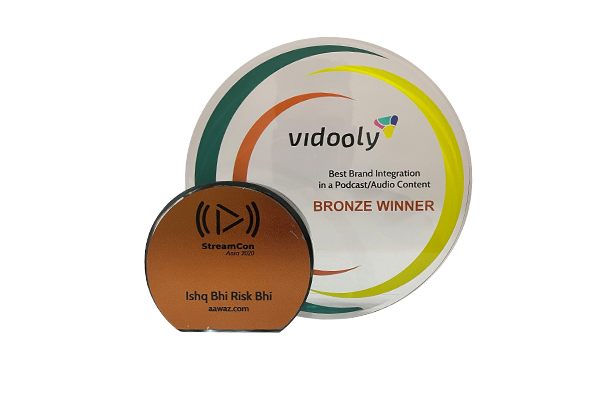
Inkspell | 2019
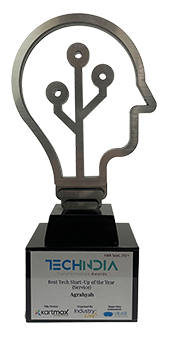
E4M Play | 2022

Digies | 2021

StreamCon | 2020